Overview
A local-first, full-stack platform for building, running, evaluating, and fine-tuning multi-agent AI systems
a visual canvas, production RAG, per-agent fine-tuning, and an agent that reviews and patches codebases, all wired end-to-end.







[!IMPORTANT] This repository is a case study, not the source. KRONOS's implementation lives in a private repository. What you'll find here is the architecture, the decisions and their reasoning, the data contracts, the screenshots, and a handful of verbatim code excerpts — everything needed to evaluate the engineering without publishing the codebase. See Source access if you need to read it properly.
Every screenshot below is from a live local instance — not mockups. The backend runs on Ollama by default (no keys, no cost, no data egress); OpenAI, Anthropic, Gemini, Mistral, and OpenRouter are one opt-in key away. See docs/adr for the reasoning behind that and every other major decision.
New here? Read the Guidebook — setup plus a hands-on tour of every feature.
134 backend source files, mypy --strict clean · 96 offline tests green (pytest -m "not live") plus a live suite against a real Ollama daemon · 9 ADRs · 12 ingestible source types · 5 agent reasoning strategies · 6 LLM providers · 8 frontend routes
Those first two numbers are the ones worth checking, so the raw output of the type-check, lint, and test runs behind them is reproduced in docs/evidence rather than asserted with a badge you can't click through to.
Contents
- Why this exists
- Architecture
- See it running
- What this demonstrates
- Code excerpts
- Tech stack
- How it runs
- Source access
- Capability map
- Documentation
- License
Why this exists
Most agent frameworks assume a cloud API key and hide their machinery behind an SDK. KRONOS was built to do the opposite on both counts: default to running entirely on your machine (ADR-0003), and own the full stack rather than wrap one — a native multi-provider LLM adapter instead of a LangChain dependency (ADR-0002), a hand-rolled hybrid retriever instead of a vector-DB SaaS, a workflow engine you can read top to bottom.
An adapter with no API key never silently falls back or mocks a response — it reports itself unconfigured and tells you exactly what to set. That "no mocks" rule extends to the test suite: the live-marked tests hit a real Ollama daemon, not a stub.
Architecture
flowchart LR
    Browser(["Browser"]) <--> FE

    subgraph FE["Frontend — Next.js 15 · React 19 · TypeScript"]
        direction TB
        Canvas["Canvas / Orchestrator<br/>React Flow, live WS state"]
        Screens["Fine-tune · Data · Import<br/>Run History · Router"]
    end

    FE <-->|"REST + WebSocket"| API["aop.api — FastAPI"]

    API --> Supervisor["Supervisor<br/>capability routing"]
    Supervisor --> Agents["5 agent strategies<br/>ReAct · Plan-Execute · Reflexion<br/>CRITIC · Tool-calling"]
    Agents --> Tools["MCP tool registry"]
    API --> Workflow["Workflow DAG engine<br/>native asyncio + LangGraph"]

    Tools --> RAG["Hybrid RAG<br/>Qdrant + BM25 → RRF → re-rank"]
    Tools --> Mem["Conversation memory"]
    Tools --> WH["DuckDB warehouse"]

    API --> FT["Fine-tuning<br/>LoRA · QLoRA · DPO · RLHF"]
    API --> Eval["Eval harness<br/>golden suites, CI gate"]
    API --> Import["Project import<br/>static + AST + LLM review → apply"]

    Agents --> LLM["Unified LLM adapter"]
    FT --> LLM
    LLM --> Ollama["Ollama (local, default)"]
    LLM --> Cloud["OpenAI · Anthropic · Gemini<br/>Mistral · OpenRouter"]
    LLM --> Tuned["Fine-tuned registry models"]

    RAG --> Qdrant[("Qdrant")]
    WH --> DuckDB[("DuckDB")]
    Mem --> PG[("Postgres")]
Live agent state reaches the browser over Redis Streams, not raw pub/sub — deliberately, so a WebSocket client that connects after a run starts still replays every step from the beginning instead of missing the early ones (ADR-0007).
See it running
Canvas — build an agent, watch it run live
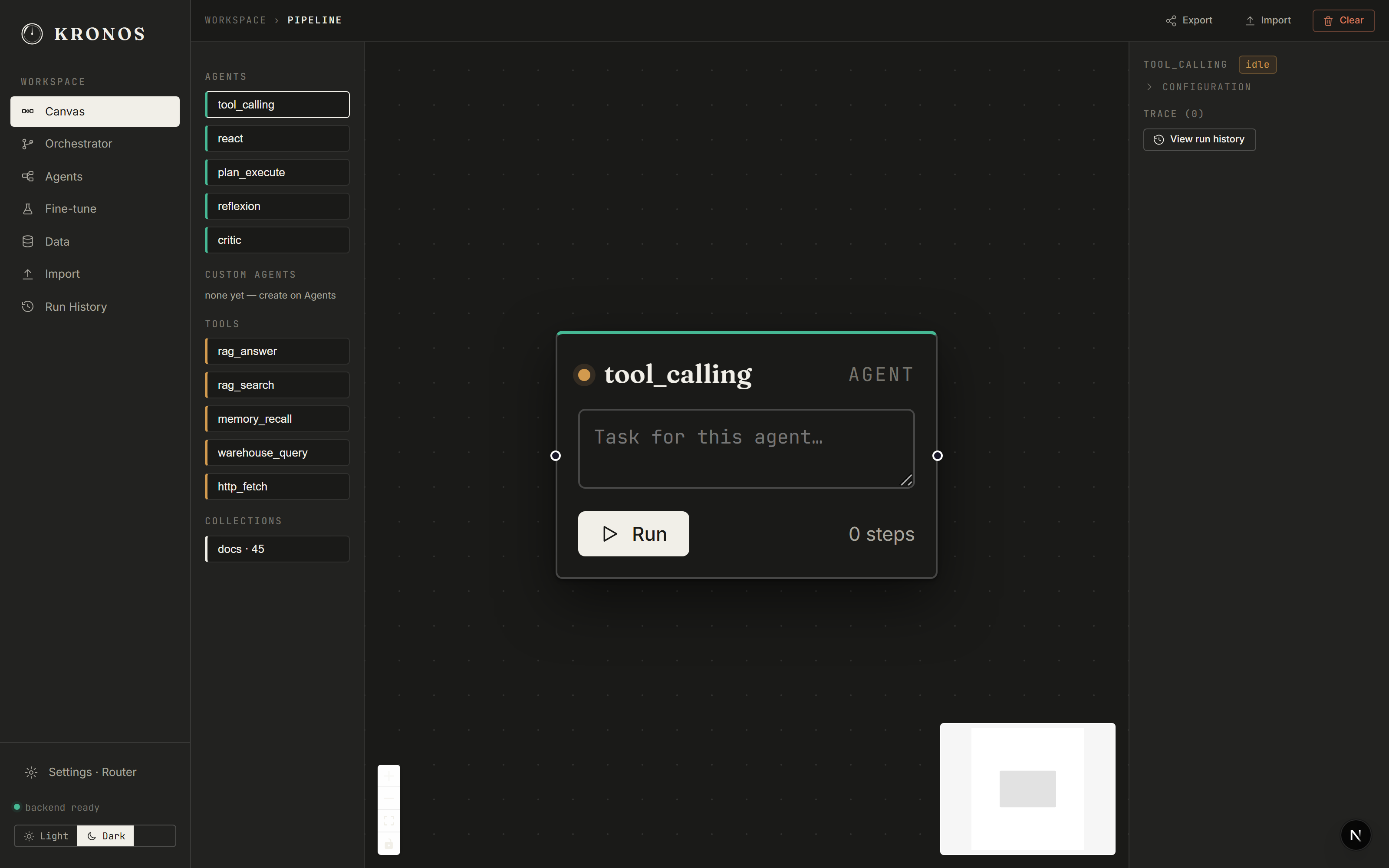
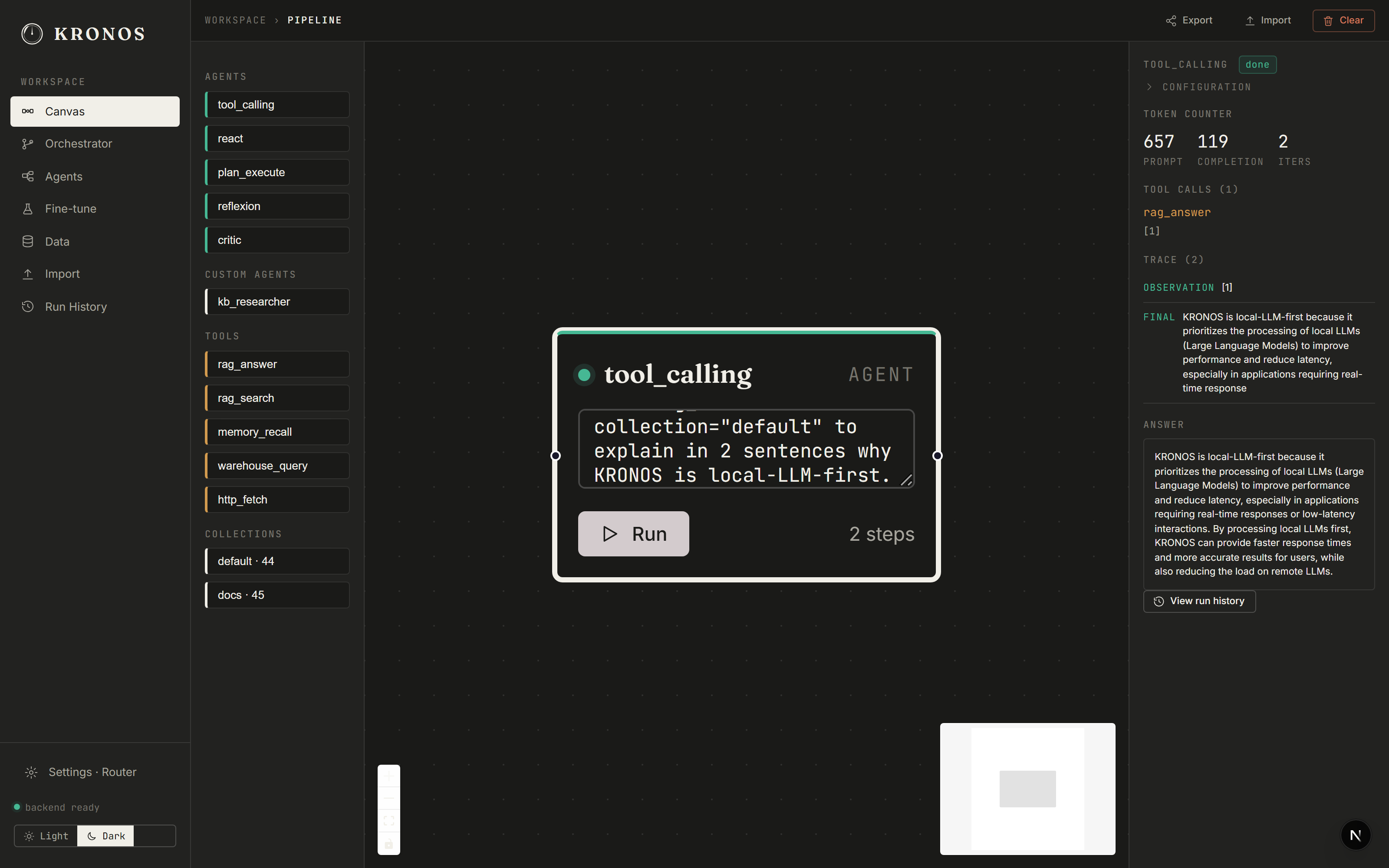
Click an agent onto the canvas, give it a task, hit Run. The run above is real: a tool_calling agent invoking the native rag_answer tool against a Qdrant collection ingested from this repo's own docs, with token counts, the tool call, and the grounded answer streaming into the Inspector live over the WebSocket.
Orchestrator — multi-agent workflows as a DAG
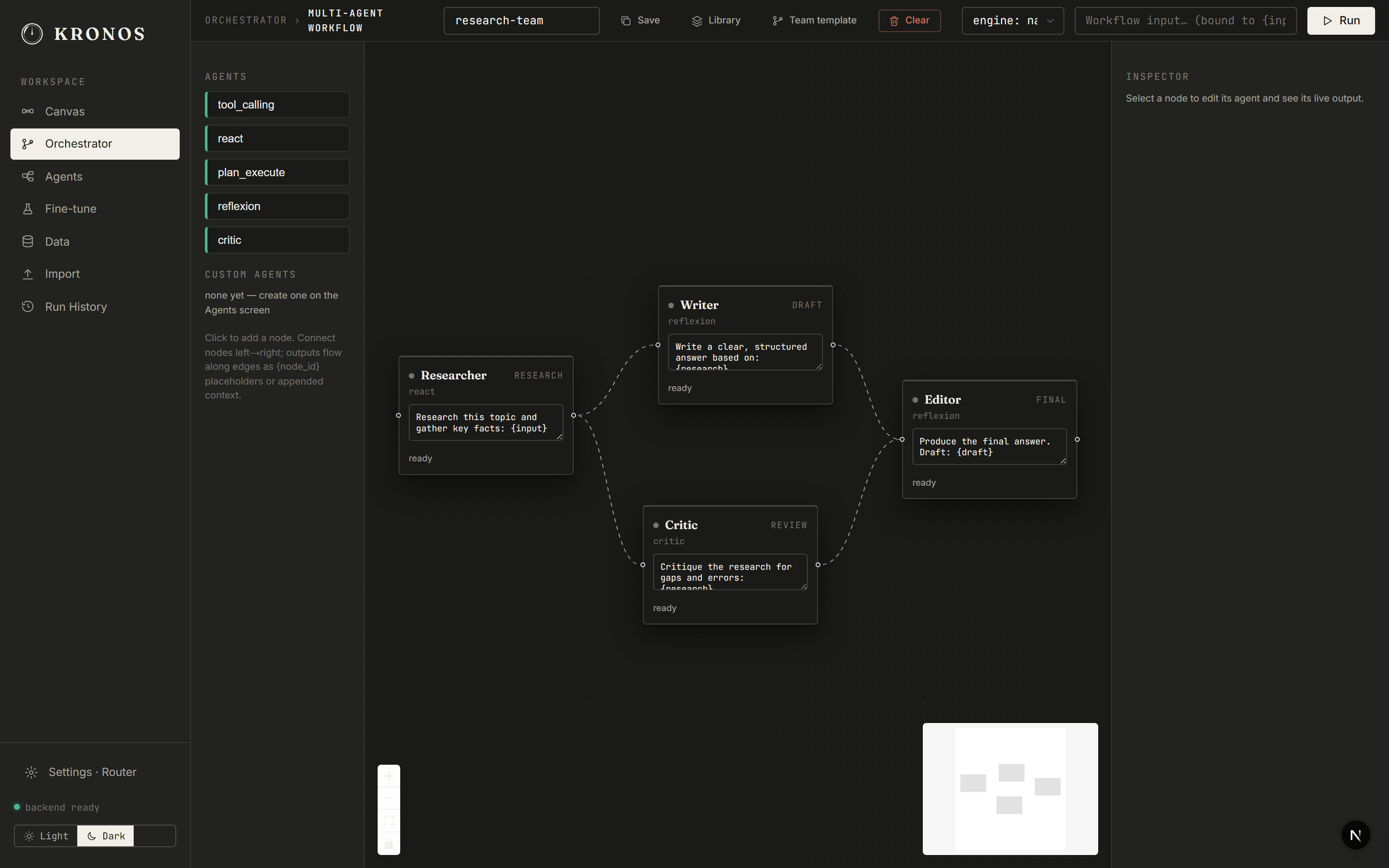
Agents become nodes in a directed graph. This research-team workflow fans out to a react researcher and a critic reviewer, then converges through a reflexion writer and editor — each node's output addressable in the next via {node_id} templating. It runs level-parallel on a native asyncio engine or an interchangeable LangGraph StateGraph backend.
Agents — a library of reasoning strategies, and a wizard to add your own
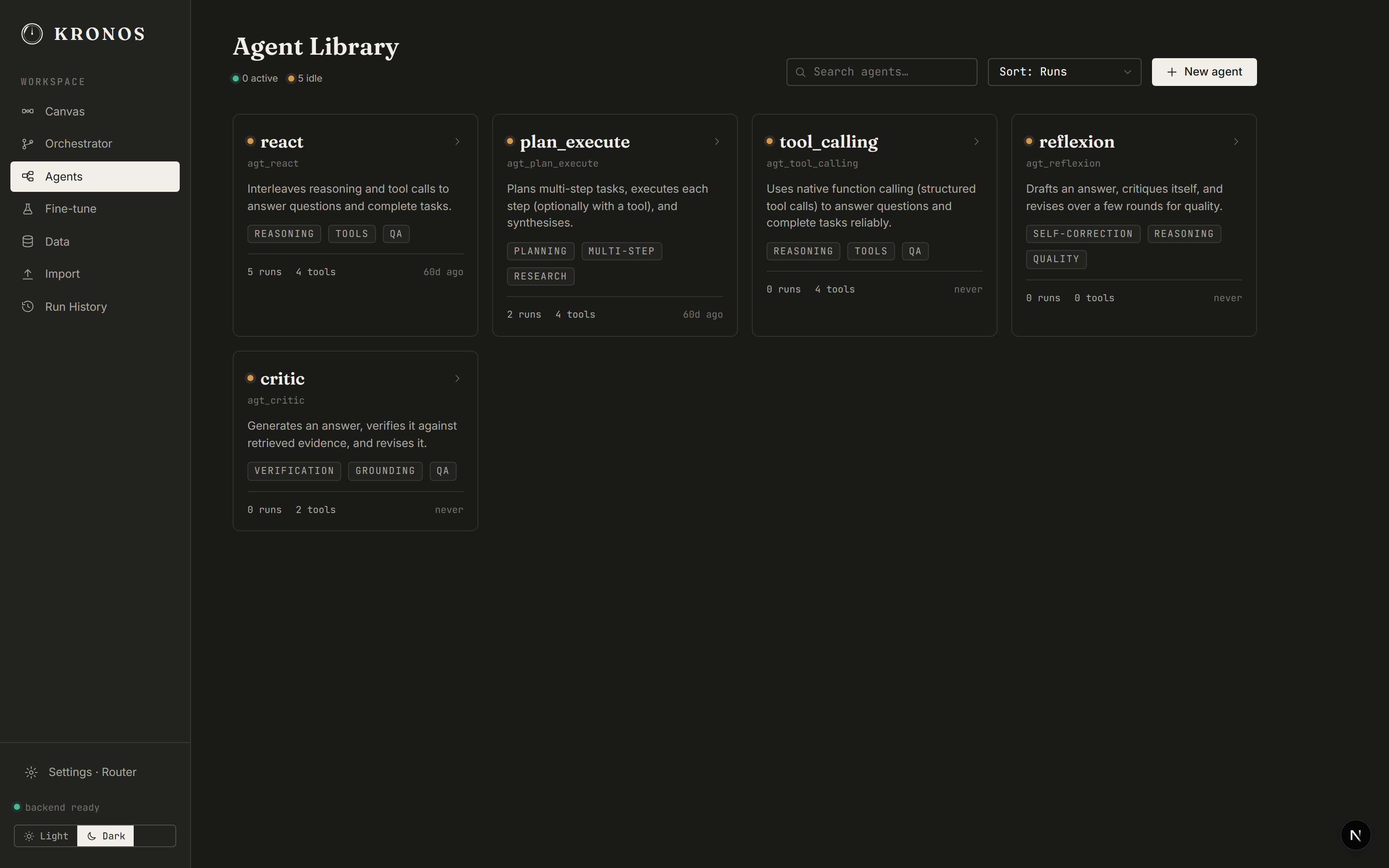
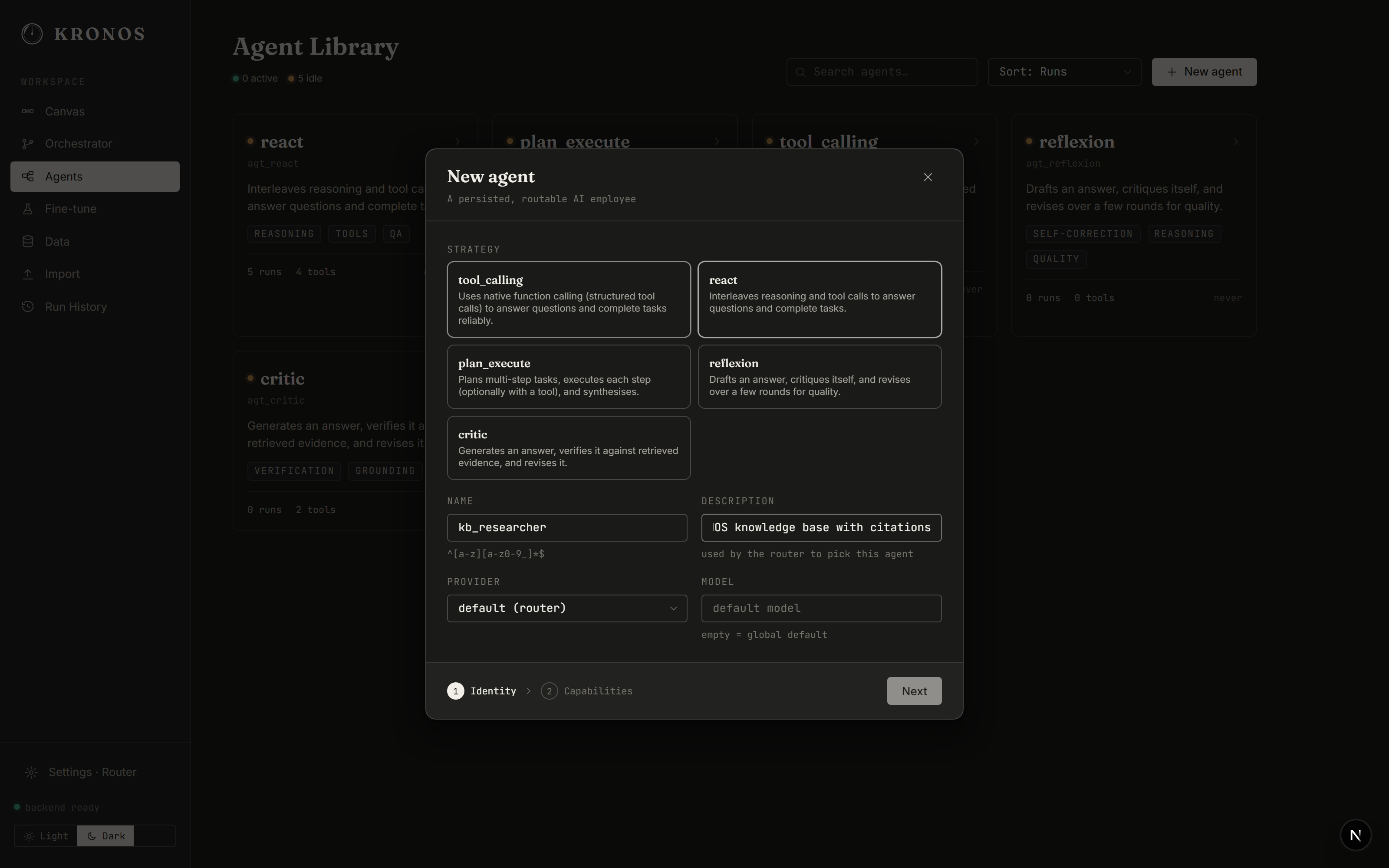
Five agent strategies ship out of the box. The New Agent wizard persists a custom agent — provider, model, temperature, system prompt, tool allowlist — that becomes a droppable, independently-tunable node everywhere in the app, immediately.
Fine-tune — LoRA/DPO training, for real, on your machine
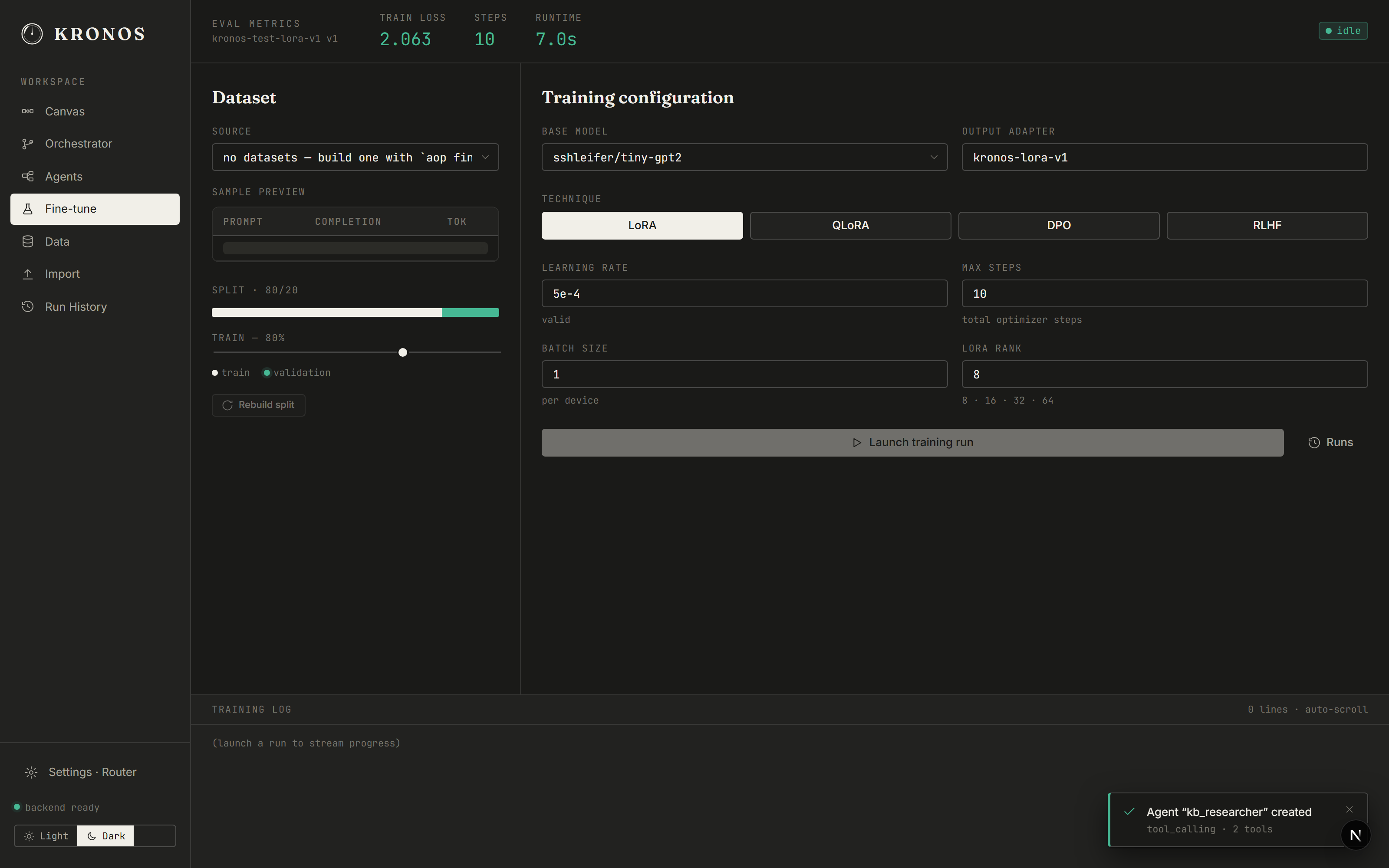
Build a train/val split from any dataset, configure LoRA / QLoRA / DPO / RLHF, and launch a real training subprocess that streams its log live. The model registry versions every run and serves it as a chat model (name@vN) — indistinguishable, to the rest of the platform, from any other provider.
Data Infrastructure — 12 source types, one pipeline
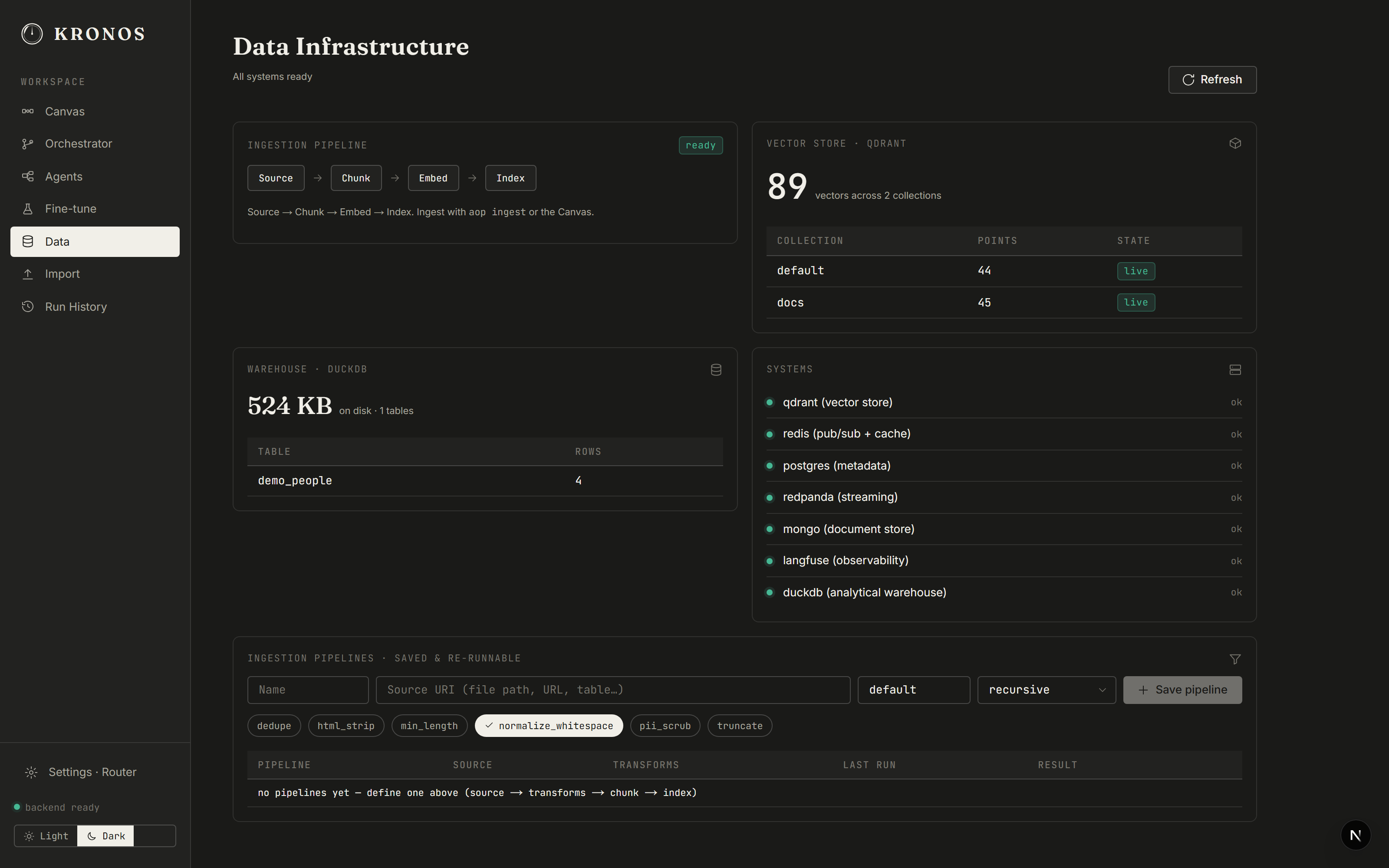
CSV, JSON, Parquet, SQL, Mongo, PDF, HTML, transcripts, BigQuery, and Snowflake all funnel through the same Source → Chunk → Embed → Index pipeline into a dual dense+sparse index and a DuckDB warehouse.
Project Import & Auto-Improvement — an agent that reviews (and patches) code
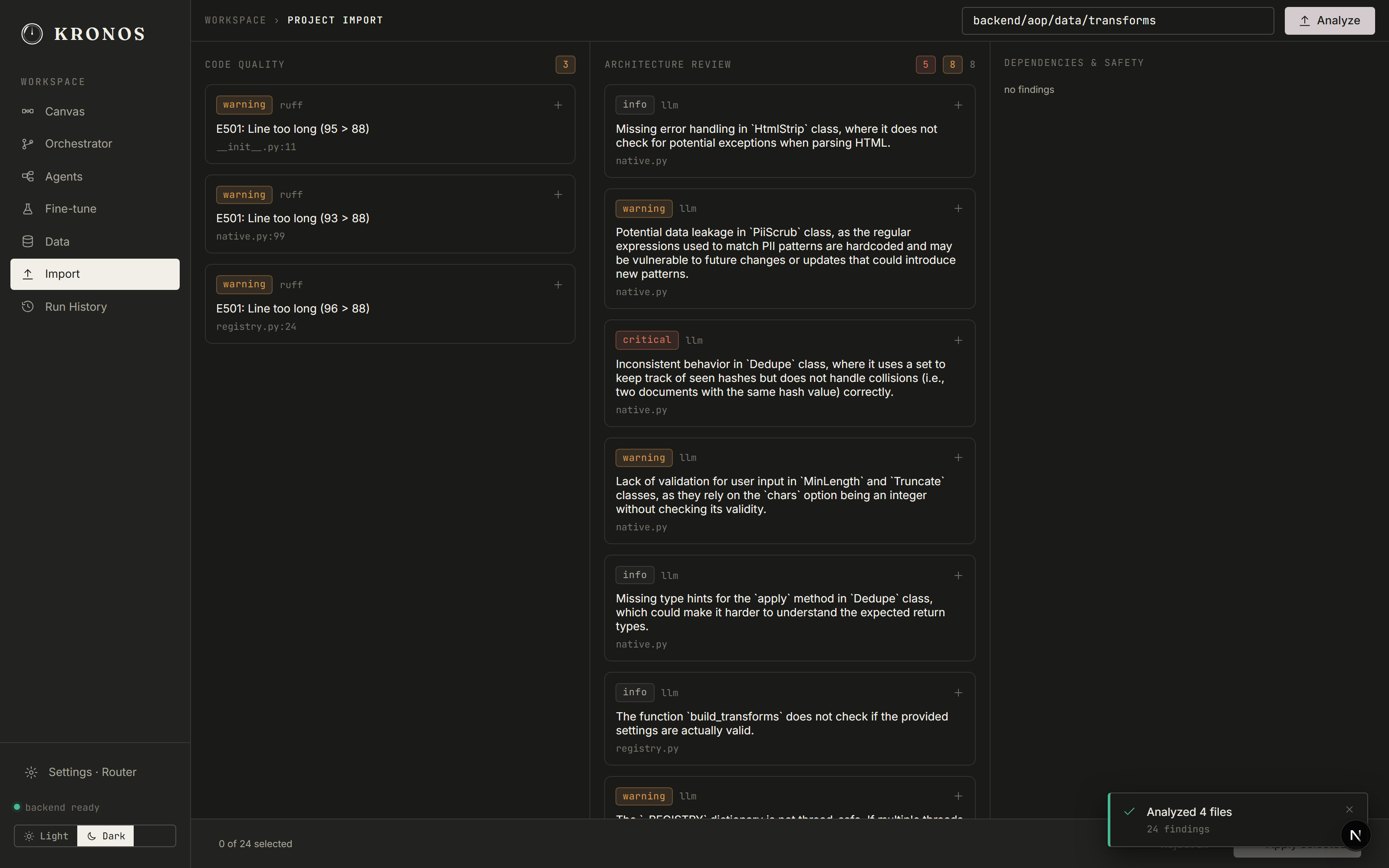
Point it at a path or a git URL; it runs ruff + mypy, AST complexity metrics, a dependency audit, ML-data-leakage heuristics, and an LLM code review — on an isolated copy, never the original. The run above is genuine: KRONOS analyzing one of its own modules, catching a real hash-collision bug in a Dedupe transform and missing exception handling in an HtmlStrip parser.
Run History — every run persisted, replayable, exportable to a dataset
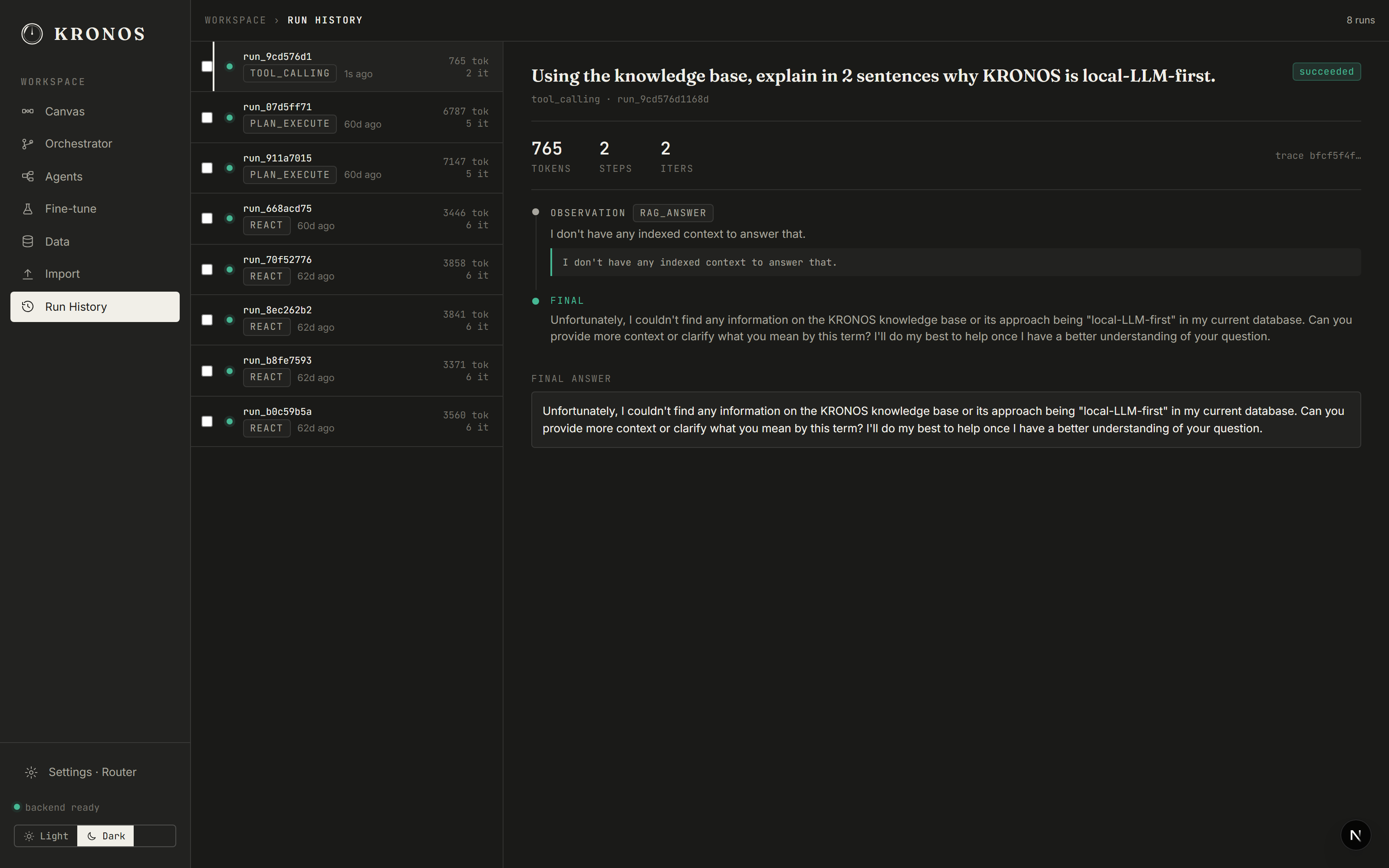
Every run is persisted with its full trace and its resolved provider/model/temperature, for reproducibility. Select a batch of successful runs and export them straight into a fine-tuning dataset — the platform's own usage becomes its own training data.
LLM Router — one interface, six providers
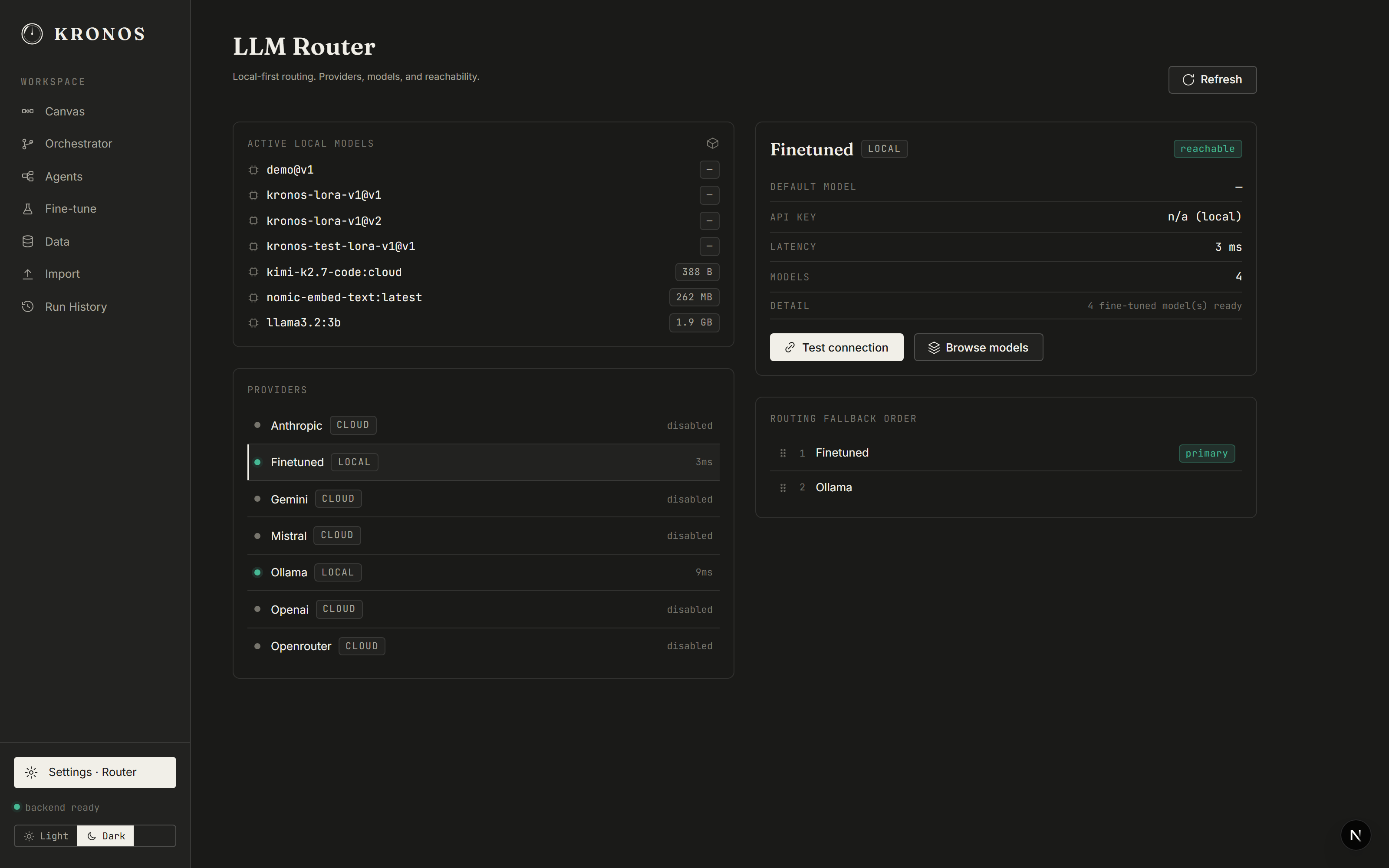
Ollama is the default and needs no key. Cloud providers are opt-in — paste a key in the UI and it's live immediately via a runtime keystore, no restart. Fine-tuned registry models are just another provider in the list.
What this demonstrates
AI/ML Engineering
- A multi-provider LLM adapter (Ollama, OpenAI, Anthropic, Gemini, Mistral, OpenRouter) behind one typed interface — chat, streaming, embeddings, native function calling, model listing, health — all real HTTP, with a typed error hierarchy, no SDK wrapper. - Five agent reasoning strategies — ReAct, Plan-and-Execute, Reflexion, CRITIC, and native tool-calling — each emitting the same structured trace contract, so a Supervisor can route between them by capability. - Hybrid RAG: Qdrant dense vectors and a BM25 sparse index fused with weighted Reciprocal Rank Fusion, Cohere/cross-encoder re-ranking, and a RAPTOR hierarchical-summary tree built with deterministic numpy KMeans instead of the paper's UMAP+GMM stack. - Fine-tuning that actually runs: LoRA and DPO complete on CPU; QLoRA and RLHF are implemented and GPU-gated, not stubbed. - An eval harness with deterministic graders (`contains`, `regex`, `tool_called`, `min_words`) that gates on a minimum pass rate — "did this change help" answered mechanically, not by vibes.Data Engineering
- 12 ingestible source types — CSV, JSON, JSONL, Parquet, SQL, MongoDB, PDF, HTML, transcripts, plain text, BigQuery, Snowflake — across 5 connector modules feeding one ingestion pipeline. - DuckDB does double duty as both the file-reading engine (native `read_csv_auto`/`read_json_auto`/`read_parquet`, no `pyarrow` dependency) and the analytical warehouse — one engine, two jobs. - Dual indexing (Qdrant dense + file-persisted BM25 sparse) behind 4 chunking strategies, including true late chunking via local token-level embeddings, not a pooled-vector approximation. - Kafka/Redpanda streaming ingestion; schema-evolving batched warehouse writes (`ALTER TABLE` on new columns) with incremental quality-metric accumulation, so memory stays bounded regardless of dataset size.Software Engineering
- `mypy --strict` clean across 134 backend source files; `ruff` (pyflakes, isort, pyupgrade, bugbear, comprehensions, simplify, async-lint, pydocstyle) as linter and formatter. - 96 offline unit/integration tests, plus a separate `-m live` suite that exercises a real Ollama daemon — no mocks anywhere, including the tests. - CI matrix on Python 3.12 + 3.14: backend (lint, format-check, strict type-check, test) and frontend (lint, typecheck, production build) as independently gated jobs. - Typed contracts end-to-end: Pydantic models generate the JSON-Schema contracts under [`docs/schemas`](schemas/README.md), mirrored by hand-written TypeScript types on the frontend. - 9 ADRs recording the reasoning behind each architectural decision, not just the result — e.g. why Redis *Streams* and not pub/sub for the run event bus ([ADR-0007](adr/0007-canvas-ui.md)).R&D
- **Project Import & Auto-Improvement**: an agent that statically analyzes, LLM-reviews, and patches arbitrary codebases on an isolated copy — including, as shown above, its own. - **Run-history → dataset flywheel**: successful runs export straight into an SFT dataset, train, register, and come back as a servable agent — a closed loop from inference to training data to a new model. - A structured, JSON-first router for agent dispatch (LLM proposes JSON → parse → regex/substring fallback → deterministic default) with every routing decision logged — an inspectable policy, not an LLM black box.Code excerpts
The source is private, so three files are reproduced in snippets/
verbatim and unedited — enough to judge how the code is actually written,
without publishing the codebase.
| Excerpt | What it shows |
|---|---|
fusion.py |
Weighted Reciprocal Rank Fusion — how dense (Qdrant) and sparse (BM25) results merge into one ranking without comparable score scales. Pure, 57 lines, no I/O. |
graders.py |
The deterministic eval graders. No LLM judging, so a given agent output always scores identically. |
llm_adapter_base.py |
The abstract LLMAdapter every provider subclasses — the seam that makes swapping Ollama for Anthropic a config change rather than a code change (ADR-0002). |
They're representative rather than flattering: typed throughout, docstrings that
state contracts instead of restating parameter names, and typed errors that
surface an unconfigured provider as UNCONFIGURED with a fix path rather than
silently mocking a response.
Tech stack
| Layer | Stack |
|---|---|
| Backend | Python 3.12+, FastAPI, Pydantic v2, Typer CLI, structlog, httpx |
| Frontend | Next.js 15 (App Router), React 19, TypeScript 5, React Flow (@xyflow/react), zustand |
| LLM providers | Ollama (default) · OpenAI · Anthropic · Gemini · Mistral · OpenRouter |
| Retrieval | Qdrant (dense) · rank_bm25 (sparse) · Cohere / cross-encoder re-ranking |
| Data | DuckDB (warehouse) · Postgres (metadata + memory) · Redpanda/Kafka (streaming) · MongoDB |
| Orchestration | Redis Streams (run bus) · native asyncio DAG engine · LangGraph backend |
| Fine-tuning | PEFT · TRL · transformers · torch |
| Observability | Langfuse v2 (self-hosted) · structlog |
| Quality | ruff · mypy --strict · pytest · ESLint · tsc · GitHub Actions |
How it runs
There's no git clone for this repository — it holds no application code. The
steps below are the real setup from the private repo, included because how a
system is operated is part of its design: one bootstrap script, a local model,
and no cloud account anywhere in the critical path.
# 0. Prerequisites: Ollama running with the default models
ollama pull llama3.2:3b
ollama pull nomic-embed-text

# 1. One-shot bootstrap: venv + install + .env + diagnostics
.\scripts\bootstrap.ps1

# 2. Validate the environment
.\.venv\Scripts\aop.exe diagnose

# 3. Talk to the local model through the unified adapter
.\.venv\Scripts\aop.exe chat "Explain RAG in one sentence."

# 4. Bring up the data stack, backend, and canvas
docker compose up -d
.\.venv\Scripts\aop.exe serve          # http://127.0.0.1:8000
cd frontend; pnpm install; pnpm dev    # http://localhost:3000
POSIX users: ./scripts/bootstrap.sh (set PYTHON=python3.12 if needed). The
Guidebook walks the same path in full, including what each
service is for and how to verify it came up correctly.
Source access
KRONOS is a personal R&D project kept in a private repository. It isn't a product and isn't accepting contributions, but the source is available for review on request — for hiring processes, technical due diligence, or a collaboration that warrants it.
Reach me at github.com/YousefHlaly and say what you'd like to look at. Read access to the private repository is straightforward to arrange; a guided walkthrough of a specific subsystem is usually more useful and I'm happy to do that instead.
In the meantime, the material here is the honest version of the same thing: the
ADRs record why each decision went the way it did (including the ones
that didn't work out), docs/evidence has the raw quality-gate
output, and snippets/ has real, unedited code.
Capability map
| Phase | Scope | Status |
|---|---|---|
| 0 | Environment bootstrap — unified LLM adapter, diagnostics, project scaffold | Done |
| 1 | Data infrastructure — 12 source types, 4 chunkers, Qdrant + BM25, DuckDB, streaming | Done |
| 2 | RAG + memory — hybrid retrieval with RRF, re-ranking, scoped + episodic memory | Done |
| 3 | Orchestrator engine — MCP tools, agent strategies, supervisor, Langfuse, FastAPI | Done |
| 4 | Canvas UI — React Flow, live run state via Redis Streams + WebSockets | Done |
| 5 | Fine-tuning control panel — LoRA/DPO real, QLoRA/RLHF GPU-gated, eval, registry | Done |
| 6 | Project import & auto-improvement — static + AST + leakage + LLM review/apply | Done |
Beyond Phase 6, shipped and verified: native function calling and a tool_calling agent strategy; a multi-agent workflow DAG engine with a native and a LangGraph execution backend; custom agents with per-node/per-run config overrides; an OpenRouter provider with a runtime API-key store and a searchable model browser; run cancellation, reproducibility stamping (resolved provider/model/temperature), and enforced-read-only warehouse access; per-run token budgets; a structured JSON-first router with logged decisions; and the golden-suite eval harness described above. See the per-phase ADRs in docs/adr and runbooks in docs/runbooks for the phased history.
Documentation
Everything below is also published as a searchable site at yousefhlaly.github.io/kronos-showcase.
| Guidebook | Setup plus a hands-on tour of every feature. Start here. |
| Architecture decisions | 9 ADRs — the reasoning behind each choice, not just the result. |
| Operational runbooks | How each phase is actually run and verified. |
| Data contracts | 34 JSON Schemas generated from the Pydantic models. |
| API reference | The FastAPI surface. |
| Code excerpts | Three real source files, verbatim. |
| Evidence | Raw type-check, lint, and test output behind the quality claims. |
Backend and frontend implementation notes live with the source, in the private repository — see Source access.
License
The KRONOS source is licensed Apache-2.0. This repository carries the same licence, covering the documentation and the code excerpts reproduced here.
Screenshots are of a local instance and contain no third-party or user data.